Arma 3 Tac Ops Mission Pack Free Download PC Game
tháng 4 30, 2018
Action Games, Simulation Games, Strategy Games
No comments
Arma 3 Tac Ops Mission Pack PC Game Download
Arma 3 Tac Ops Mission Pack PC Game Features:
Arma 3 Tac Ops Mission Pack Game System Requirements:
Arma 3 Tac Ops Mission Pack Free Download PC Game Now:
Megaton Rainfall Free Download PC Game
Megaton Rainfall PC Game Download
Megaton Rainfall PC Game Features:
Megaton Rainfall Game Minimum System Requirements:
Megaton Rainfall Free Download PC Game Now:
Ben 10 Free Download PC Game
Ben 10 PC Game Download
Ben 10 PC Game Features:
Ben 10 Game Minimum System Requirements:
Ben 10 Free Download PC Game Now:
April updates: hex grid guide, load time
The past 7 weeks I've been working on my guide to hexagonal grids. Over the years I accumulated a long list of TO DO items on my Trello page, and I finally went through that list and implemented lots of them. Two blog posts ago I described rewriting it from an imperative style to a declarative style, and switching from manual to automatic dependency tracking. In the last blog post I described many of the improvements I made to the diagrams, including several new ones.
As I've added to the page over the years, it's become slower and slower. The main problem is the page loading time. The HTML loads, then the Javascript loads, then the Javascript runs to create the diagrams, sample code, and some of the text of the page. If you follow a link to a specific section, the browser jumps to that section, but then the layout changes as more content is added to the page by the Javascript. This is an unpleasant experience.
One of the goals of the code rewrite was to enable a fix to the problem: prerendering the diagrams on the server. There are libraries like d3-pre that can help with this, and using a virtual DOM library like React or Vue can also help with this. I ended up using Chrome to perform the prerender:
$HOME/Applications/Google Chrome.app/Contents/MacOS/Google Chrome \
--headless --disable-gpu --dump-dom \ "http://localhost/grids/hexagons/pre-index.html" \
>index.html
This will run Chrome on the web page and dump the resulting DOM, which includes all the diagrams and other generated content.
If there's any code that should only run on either the server or client, you can detect headless Chrome with:
const isRunningInHeadlessChrome =
/HeadlessChrome/.test(window.navigator.userAgent);
On the server, I render the content immediately; on the client, I delay it a little bit to keep the UI responsive.
I also made a few other changes, including using <link rel=preload> to load preload images (there aren't many) and <script defer> to defer script execution until the page is loaded.
The result?

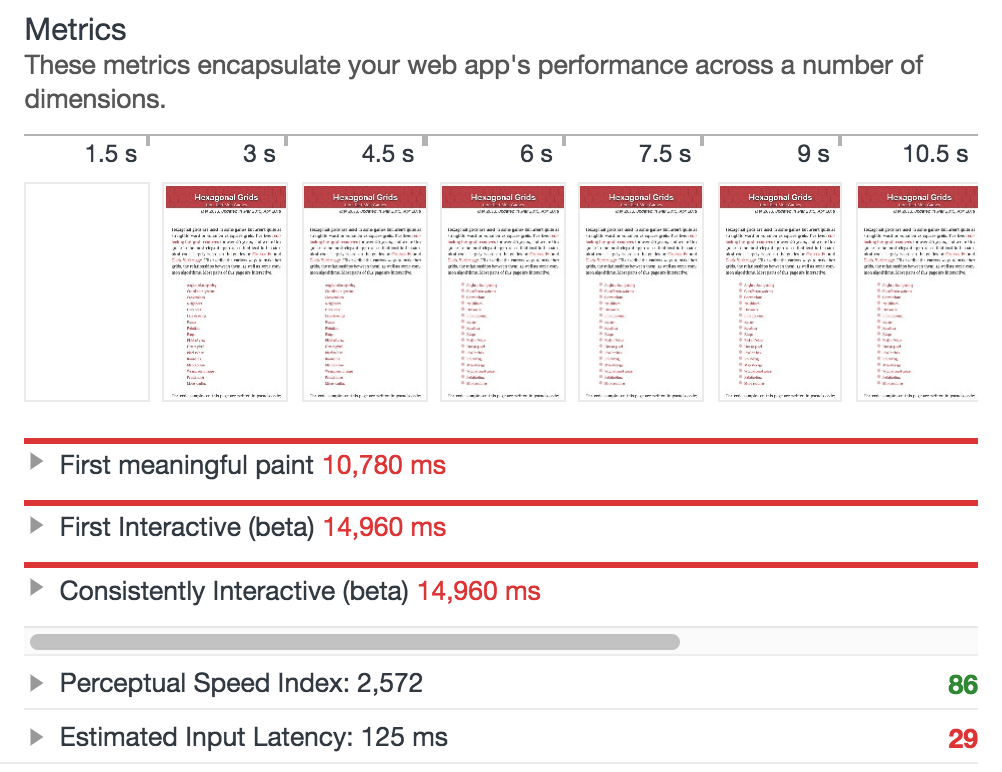
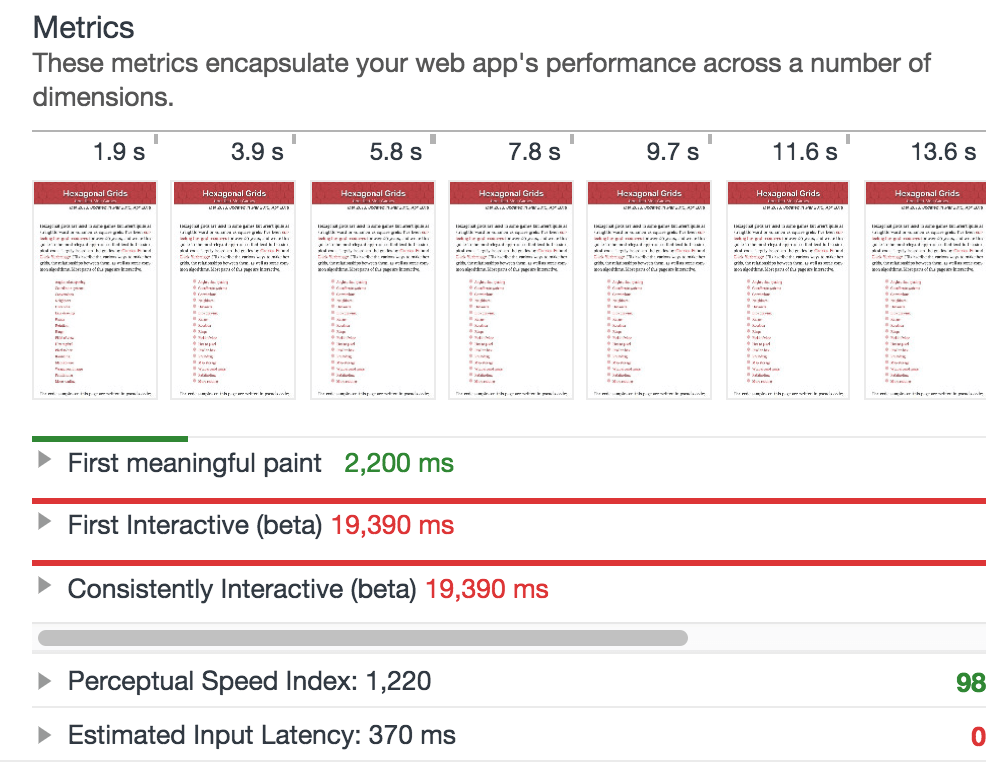
“First meaningful paint” went from 10.8 seconds to 2.2 seconds. Linking to a specific part of the page works reasonably well now.
The downside? The other metrics don't look as good. And the index.html page went from 120k to … nearly 600k. Ugh! (This is even after rounding off all the coordinate values so that the SVG text would be smaller.)
Overall though the new version feels better to me. I haven't tested with a variety of devices or network connections though. If you want to compare, clear your cache and compare the old version to the new version. Leave your notes in the comments. Thanks!
I'm happy with the updates I've made, and I'm going to wrap this up and move on to another project.
Road Rage Free Download PC Game
Road Rage PC Game Download
Road Rage PC Game Features:
Road Rage Game Minimum System Requirements:
Road Rage Free Download PC Game Now:
Outcast Free Download PC Game
Outcast PC Game Download
Outcast PC Game Features:
Outcast Game Minimum System Requirements:
Outcast Free Download PC Game Now:
LEGO Marvel Super Heroes 2 Free Download PC Game
LEGO Marvel Super Heroes 2 PC Game Download
LEGO Marvel Super Heroes 2 PC Game Features:
LEGO Marvel Super Heroes 2 Game System Requirements:
LEGO Marvel Super Heroes 2 Free Download PC Game Now:
LEGO Marvel Super Heroes 2 Game Installing Process:
Outcast Second Contact Free Download PC Game
Outcast Second Contact PC Game Download
Outcast Second Contact PC Game Features:
Outcast Second Contact Game Minimum System Requirements:
Outcast Second Contact Free Download PC Game Now:
Outcast Second Contact Installing Process:
April updates: hex grid guide, iteration
One of my goals this year is to iterate more. I have a tendency to "launch" a page and then move on to the next topic. Instead, for the first few months of the year I decided I would go through my existing pages to:
- figure out how the content could be better (explanations, diagrams, user interface, little details)
- figure out how the tech could be better (load time, animation code, diagramming code, code structure)
Over the past 6 weeks I've been working on my guide to hexagonal grids. I first worked on the tech, switching from an imperative style to a declarative style, and also switching to a library with automatic dependency tracking. Then I worked on content updates, some of which I described in my previous blog post. In the past week I've been going through my list on trello and implementing more content updates:
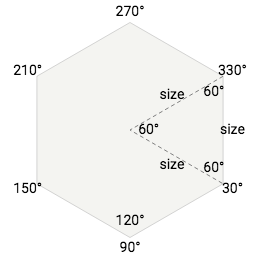
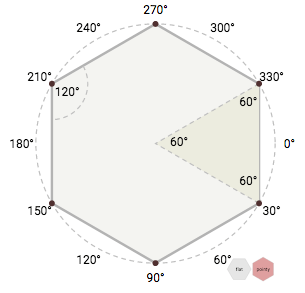
- Angles diagram: added the circumcircle to show that the corners are always on a circle; added dots on the corners to emphasize this; changed the 6 sliding angle labels (30°, 90°, etc.) into 12 static angle labels; fixed a bug in the angle calculations.


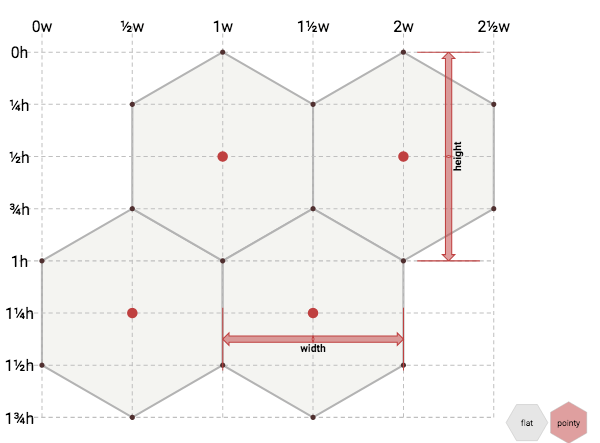
Angles diagram: before and after - Size/spacing diagram: added arrows showing the horizontal/vertical size or spacing, on mouseover

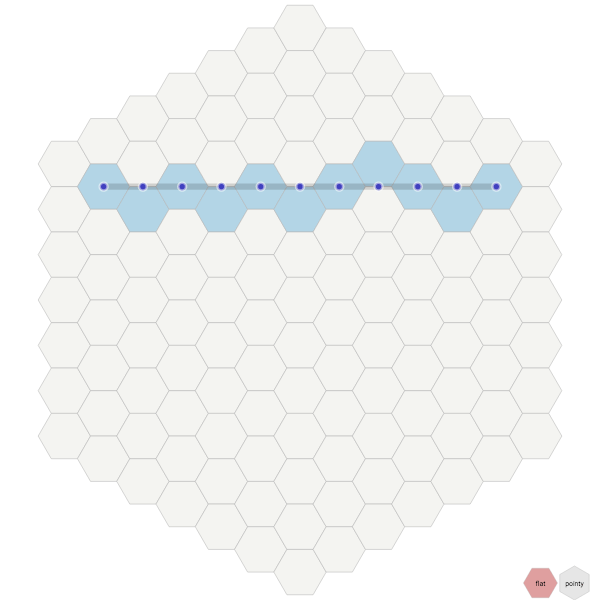
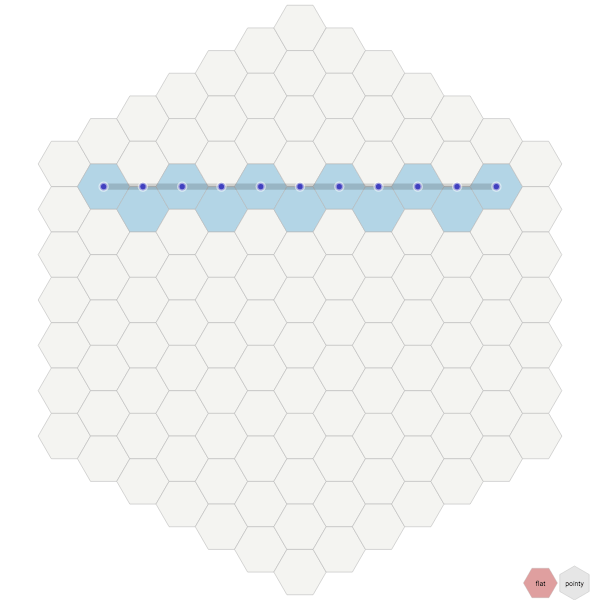
Size/spacing diagram: arrows - Line drawing diagram: fixed a bug that my rewrite reintroduced (oops!), and that the article even tells you how to fix.


Line drawing diagram: before and after bug fix - Many diagrams: show values with signs:
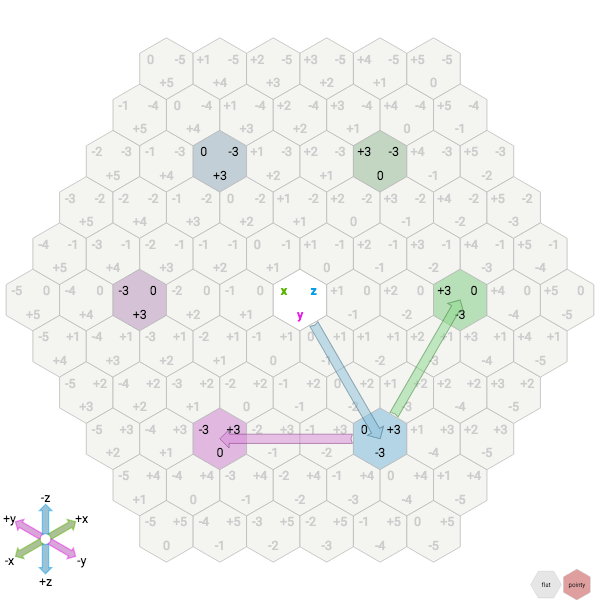
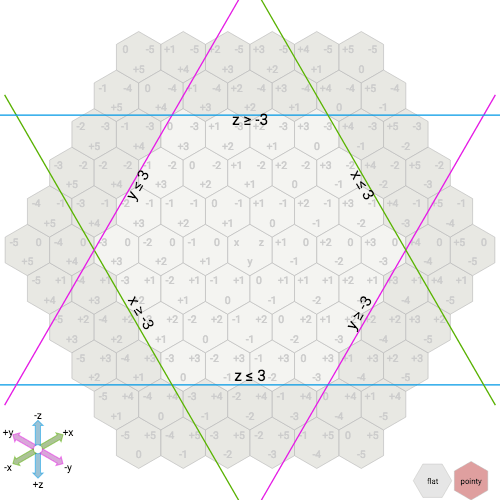
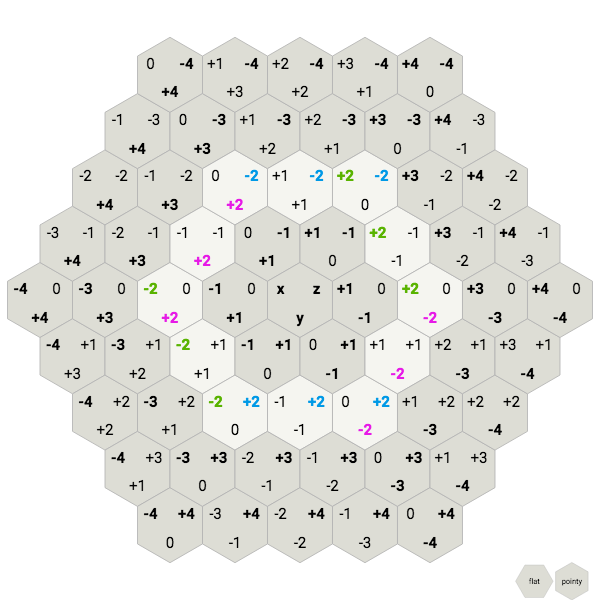
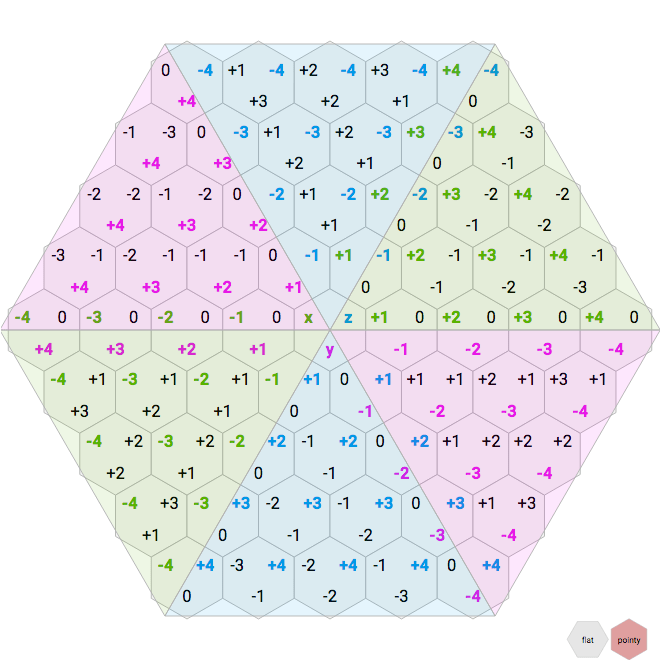
+N,-Ninstead ofN,-N - Cube coordinates, axial coordinates, coordinate range, rotation diagrams: added a legend showing the axes, because it's easier to understand those coordinate systems and algorithms when you can see the axes. The axes themselves are the same ones as in the axes section, which I'm considering removing.


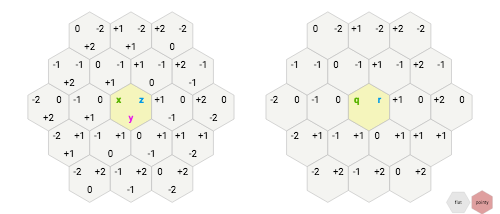
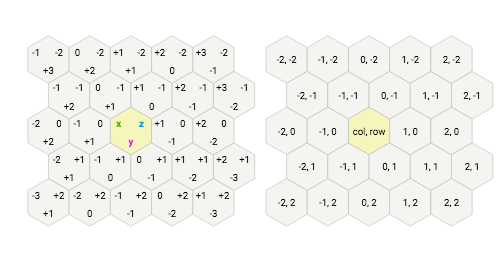
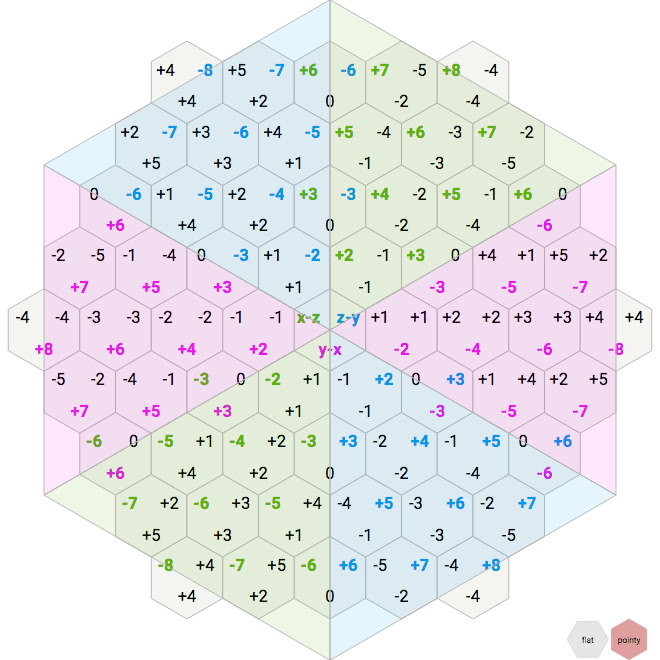
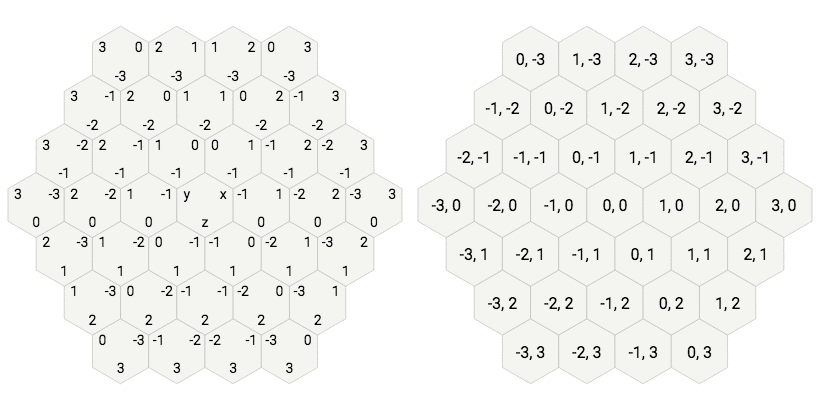
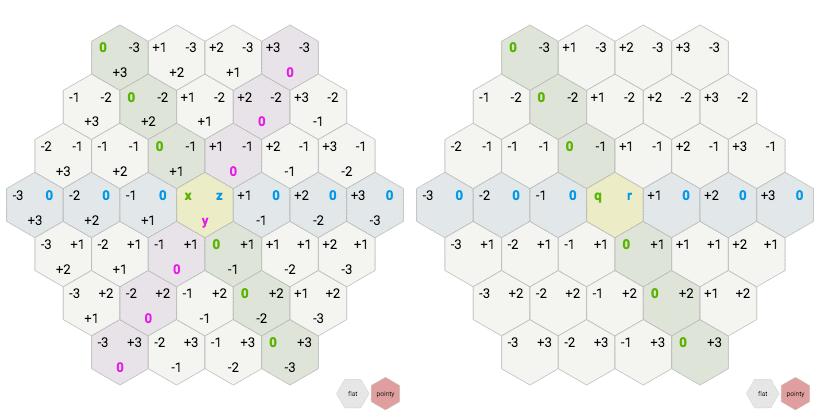
Several diagrams: axes legend in lower left - Axial conversion, offset conversion sections: added diagrams to visually show what the pseudocode was computing, with side-by-side grids with two different coordinate systems. If you're implementing your own code for conversion, you can now use these diagrams to get reference values for your test cases.


Conversion sections: new side-by-side diagrams - Distances diagram: this had too much color to be readable, so I removed most of the color, and highlighted one distance at a time. I'm still not happy with it but it's easier to read than before. More iteration needed.


Distances diagram: before and after - Library code: rearranged code so that I can reuse the hex library and diagram code on more than one page. Changed the implementation page to use the same code as the main page.
- Direction diagrams: the old super-colorful distances diagram also doubled as a way to see that each of the six wedges has its own properties. Since the new diagram is no longer colorful enough to see this, I made a separate page for this. This was a test case for being able to make multiple pages that share the diagram code.


Direction diagrams - Many diagrams: changed the highlight color from medium blue to yellow to increase contrast of labels, and make them easier to read. Also, blue is used for
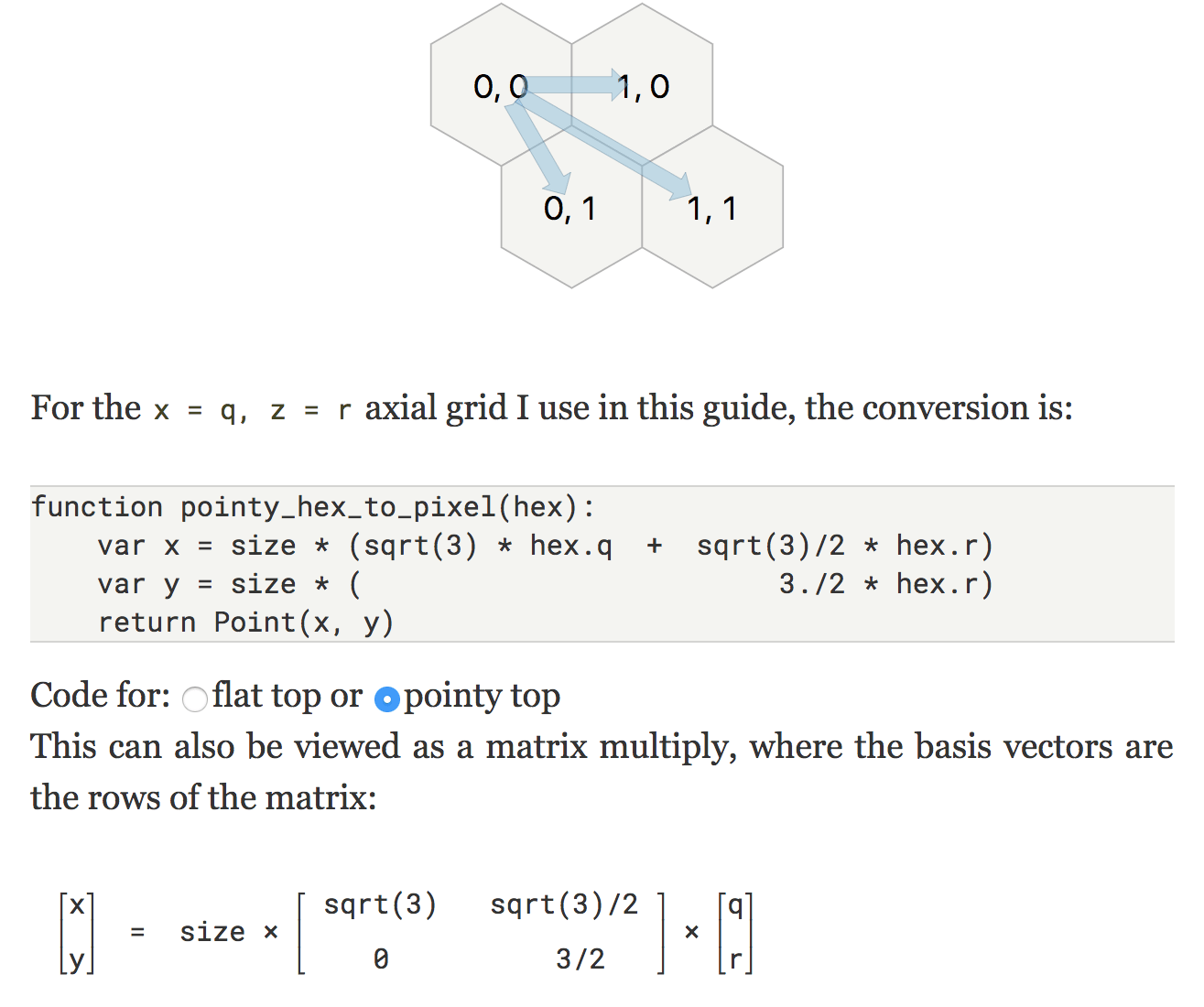
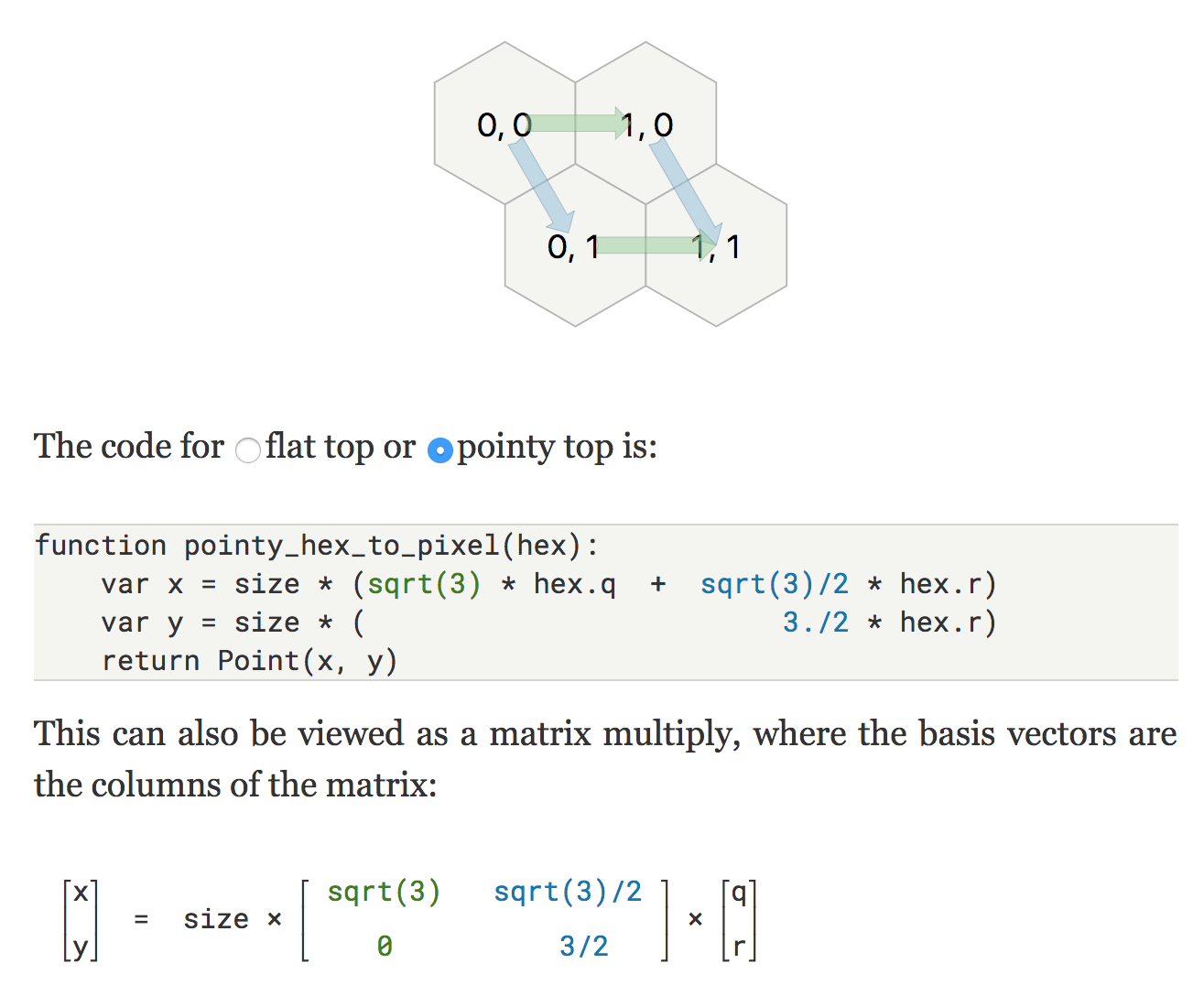
x,q, andcolcoordinates, so using also blue as a highlight color led to some ambiguities. For example, in the map storage diagram, I used to highlight the row in blue, even though rows are usually green. Now the row is green and the hex is yellow. - Hex-to-pixel diagram: added color to the basis vectors in the diagram, the code, and the matrix, showing that basis vectors are key to this algorithm.


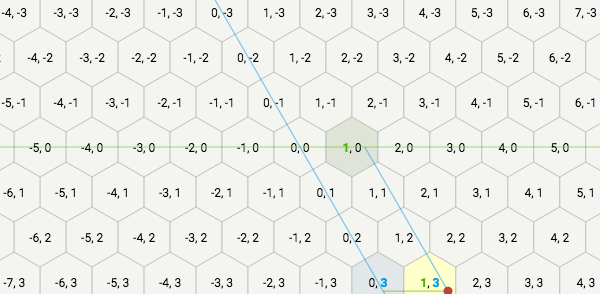
Hex-to-pixel: before and after - Pixel-to-hex diagram: since pixel-to-hex is the inverse of hex-to-pixel, added the same colors to the diagram, the code, and the matrix; showed that the pixel-to-hex matrix is the inverse of the hex-to-pixel matrix. This is another example of how the blue highlight is misleading, and how yellow won't be confused with one of the basis vectors.


Pixel-to-hex diagram: before and after
I'm quite happy with how much easier these changes were to make with the new declarative code compared to the old imperative code. I had wanted to make some of them before, but it was a lot of work with the old code structure, so I never got around to them.
This week's project is to work on load time. Both the hexagon guide and the A* pages load far too slowly. The main reason is that the diagrams are generated after the entire page loads. I'd like to generate the initial diagrams on the server and send them to the browser. That way they're already there before any Javascript is parsed or executed. However, my old imperative code structure made this a lot of extra work. The new declarative approach should make this easier to implement.
South Park The Fractured But Whole Free Download PC Game
South Park The Fractured But Whole PC Game Download
South Park The Fractured But Whole PC Game Features:
South Park The Fractured But Whole Game System Requirements:
South Park The Fractured But Whole Free Download PC Game Now:
Sword Art Online Hollow Realization Deluxe Edition Free Download PC Game
Sword Art Online Hollow Realization PC Game Download
Sword Art Online Hollow Realization PC Game Features:
Sword Art Online Hollow Realization Game System Requirements:
Sword Art Online Hollow Realization Deluxe Edition Free Download PC Game Now:
UCLan Games Jam 2018
Our 1st and 2nd year Games Design students team up on an annual basis with Music Production and Screen Writing students for the UCLan Games Jam. This never fails to make the final three weeks of Semester 2 challenging and memorable for us all.
This year the theme of the Games Jam is 'Negative Space' and our students are working excitedly in the studios in a relaxed and informal atmosphere to compete to meet the challenge. We've invited several Industry Visitors to come into the studios to see the work the students are doing for Uclan Games Jam.
We love our students to get feedback from people in the industry

Thurs 19th April with Scott Swarbrick of Milky Tea Studios,
plus a visit from Games Designer, Peter Field of 'Media Molecule' on Friday 27th April
for the BIG finale and prizes!
There's lots of exciting ideas and discussion going on within each of the seven teams and it's great to see the progress on their games!
For further details see:
https://www.uclan.ac.uk/about_us/case_studies/game-jam-2018.php
April updates: hex grid guide
“We can rebuild it—we have the technology.”
Over the past few weeks I've been reimplementing my guide to hexagonal grids. I'm generally not a fan of rewrites that have no end-user benefits but there are lots of improvements I want to make to the page, and the convoluted code was making it harder to make the changes I wanted. I ended up spending 60 hours on this, reduced the number of lines of code from 2400 to 1400, and reduced the total Javascript sent to the browser (gzipped) from 85k to 54k. A large part of this was rewriting the diagrams to use Vue.js instead of D3.js. As much as I love D3, there's not much on the hexagon guide that benefits from it, and I ended up using it as a nicer JQuery. In a previous blog post I described wanting dependency tracking. That's why Vue.js worked well for this page. I think React would've been a reasonable choice as well, but on this page Vue fit my needs better.
Part of the motivation for this rewrite was to enable server-side rendering. The page has 29 diagrams, and it takes a while to generate them all while the page is loading. The initial SVGs are the same each time, so why not pregenerate them on the server? From my initial tests, the server-side rendered page renders much quicker because it's not waiting for any Javascript. However, I still need to test this a lot more, and it'll have to wait for another day.
One of my goals this year is to make lots of improvements to my existing pages.
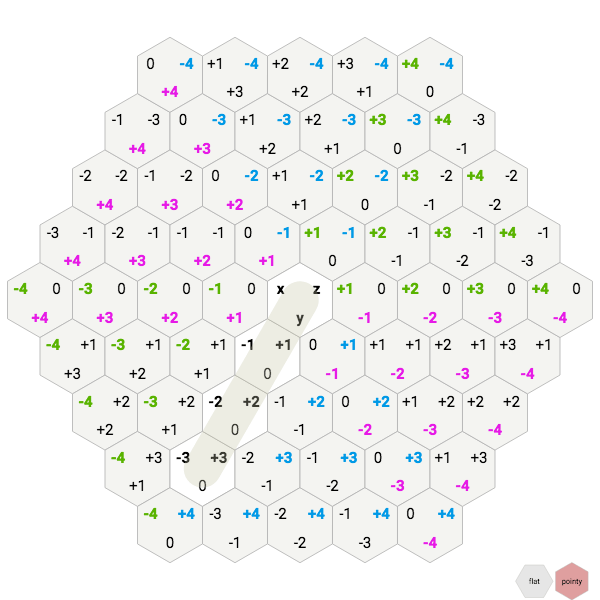
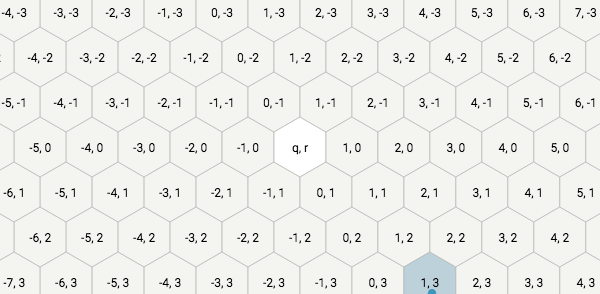
Here's an example of a small change. The cube and axial grid diagrams have coordinates written in each hex. In the new diagrams, I made these line up to show the correspondence between the two systems.


While rewriting the code I made lots of small changes:
- All the hex code used to implement these diagrams is from the procedurally generated code shown on the implementation page (this is one way to make sure that code works!)
- Pseudocode is now consistent:
varfor declarations;#for comments;OffsetCoordinstead ofHexfor offset coordinates (because Hex is axial and has different properties); consistent indentation; a different name for each function instead of reusing them for different grid types - Animation: no longer runs on initial load (it was never meant to but I never fixed it until now); has a tiny bit of "bounce"; pointy/flat layout animation uses rotation instead of sliding, which results in a better sense of how the layouts are related (see sliding in diagram 1 and rotation in diagram 2 on this test page); tied to Interaction Observer (previously was my own hacky code that watched the scroll position)
- All diagrams: fixed clipping issues so all diagrams are completely visible; initial state of diagram is non-empty so that you can see results before interacting with it (this helps when you're quickly scanning the page to find the diagram that has what you want, because you don't have to interact with each one to see the output)
- Most diagrams: added a small button to toggle pointy/flat the orientation (in the old page, you had to scroll up quite a bit to find these buttons near the top of the page)
- Interaction: touch events now work to highlight a hexagon; wall drawing works with mouse drag (but not with touch)
- Angles diagram: added an arc for the interior angle; added shading to the triangle
- Size and spacing diagram: added dots on corners to show how they line up with the axes; animated the axes change including fading labels in/out (old diagram abruptly switched axes - see comparison); changed the text to match the labels on the diagram; cleaned up the wording of the text
- Coordinate labels on many diagrams:
+sign to positive numbers to better distinguish positive and negative values; make cube and axial coordinate values line up (as shown above) - Cube/hex animation diagram: changed animation to be physics-based, with cubes falling down instead of to the right; changed colors to match the colors of the rest of the hex diagrams; added a little "bump" to the animation to make it look like the cube is being dislodged from the larger structure
- Conversions pseudocode: changed the radio button for choosing the grid type so that you can click anywhere on the line (using the <label> tag)
- Neighbor diagrams: made mouseover on the code also highlight the diagram (previously mouseover on the diagram would highlight code but not vice versa)
- Diagonal neighbor diagram: made mouseover work (bidirectionally) (previously this diagram didn't have any mouseover), sharing code with the other neighbor diagrams
- Line drawing diagram: made the circles a little bit bigger; showed the value of N in the text
- Coordinate range diagram: showed the coordinates so that you can verify that the constraints hold; renamed from dx,dy,dz to x,y,z for consistency with other diagrams
- Intersecting range diagram: colored both center points instead of only one
- Obstacles section: annotated variables with types in the pseudocode
- Hex to pixel diagram: changed the code to show the matrix structure; added the matrix values; rotated the diagram to match the flat/pointy variant you've chosen for the pseudocode (previously the diagram wouldn't match)
- Pixel to hex diagram: choose flat/pointy, and see the diagram, code, and matrix match (previously the diagram didn't change to match); emphasized that pixel-to-hex inverts the hex-to-pixel matrix; made the code show the matrix structure
So you might be wondering, so what? These are all minor changes. I agree! Those of you writing games probably know this already: lots of tiny things make a difference in how a game feels. The same is true for these pages. Polish, iteration, and "juicing" all affect how the page feels. I'm trying to iterate more this year, making these kinds of changes and also improving the code so that I can make even more changes. I plan to continue making small improvements to the hex diagrams over the next few weeks.
Sphinx And The Cursed Mummy Free Download PC Game
Sphinx And The Cursed Mummy PC Game Download
Sphinx And The Cursed Mummy PC Game Features:
Sphinx And The Cursed Mummy Game Minimum System Requirements:
Sphinx And The Cursed Mummy Free Download PC Game Now:
ELEX Free Download PC Game
tháng 4 16, 2018
Action Games, Role-Playing Games
No comments
ELEX PC Game Download
ELEX PC Game Features:
ELEX Game Minimum System Requirements:
ELEX Free Download PC Game Now:
Hand of Fate 2 Free Download PC Game
tháng 4 15, 2018
Action Games, Role-Playing Games
No comments
Hand of Fate 2 PC Game Download
Hand of Fate 2 PC Game Features:
Hand of Fate 2 Game Minimum System Requirements:
Hand of Fate 2 Free Download PC Game Now:
Dungeons 3 Free Download PC Game
tháng 4 15, 2018
Simulation Games, Strategy Games
No comments
Dungeons 3 PC Game Download
Dungeons 3 PC Game Features:
Dungeons 3 Game Minimum System Requirements:
Dungeons 3 Free Download PC Game Now:
Dungeons 3 Installing Process:
UCLan Alumni Steph McStea named in the 100 rising stars of the UK games industry.
tháng 4 15, 2018
UCLan Alumni Steph McStea named in the 100 rising stars of the UK games industry.
No comments
So thrilled to see our lovely Alumni, Steph Mcstea @TeaAndMonsters named in the 100 rising stars of the UK Games Industry!
Check out the interviews with the winners of this year's GamesIndustry.biz 100 in the link below.https://wwgamesindustry.biz/top100/2018/s
Steph's website is in the link below.
Steph is very passionate about games and has her own distinctive art style.
She was a first class honours student at Uclan Games Design Course and graduated with both a BA and MA in Games Design. During her time in study, she never failed to help and encourage others to achieve their goals in games and she was involved in many projects, including the development of the 'Plinky Plonk App', leading the UCLan Games Society and site organiser for the Global Games Jam.
Steph attended the annual Women in Games Conferences as a student where she found much encouragement and had the chance to network with some very interesting people from the industry.
She is currently working as a QA analyst for Team 17 in Yorkshire.